A Pocket Travel Record for the Journey Home
A pocket travel record keeps trip details, vivid impressions, and open questions together, making it easier to recall the journey without writing a full diary.
The common mistake with a pocket travel record is trying to turn it into a diary: after a long day, a tired traveler faces a blank page, writes nothing, and loses the small details that would have brought the trip back later. A better record takes only a few lines at a natural pause. It holds practical facts, one clear impression, and any question still hanging over the day.
What should a pocket travel record remember?
Think of the record as a handful of retrieval clues, not a transcript. Months later, “walked around town” gives little back. “Blue-tiled doorway beside the bakery; rain on the harbor rail; ask what the green ferry flag means” can reopen a scene and point toward something worth learning.
Keep three kinds of notes in view:
- Useful detail: a place name, a route change, a dish to identify, or where you left something you will need again.
- One impression: a sound, color, texture, or brief encounter that made the day feel distinct.
- Unfinished question: something to check, ask, or decide later.
These prompts are small on purpose. They make the record usable on a train platform or beside a café cup, rather than demanding a quiet hour and a perfect memory.
How does a pocket travel record take shape?
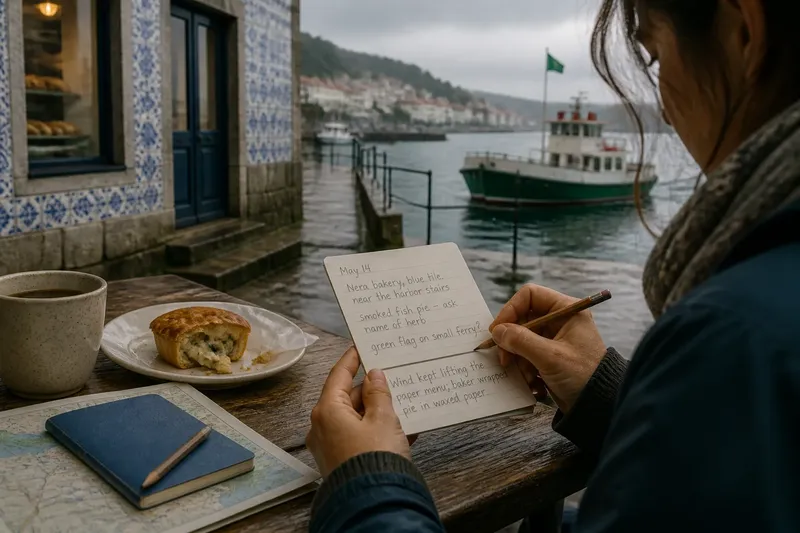
Imagine a traveler called Maya, invented for this example, spending a day in a coastal town. She carries a folded index card and a pencil in the pocket of her jacket. At lunch, she writes “Nera bakery, blue tile, near the harbor stairs,” then adds “smoked fish pie—ask name of herb” and “green flag on small ferry?” Those fragments preserve a place, a sensory detail, and two questions without interrupting the afternoon.
That evening, Maya adds a short line: “Wind kept lifting the paper menu; the baker wrapped the pie in waxed paper.” The line is not a review or a polished scene. It is an anchor, with enough texture to distinguish this meal from another.
The next morning, she learns the herb’s name from a menu and writes it beside the question. The ferry flag remains unresolved, so she leaves it open rather than guessing. A useful record can contain blanks; unanswered questions are part of the trip, not a flaw in the notes.
When is the easiest time to write?
Attach a note to a moment that already exists: while waiting for a connection, after ordering food, or just before putting the day’s ticket away. A few words entered close to the event are often more distinctive than a longer account attempted days later.
Choose one capture method and keep it simple. A small notebook suits anyone who likes handwriting and can keep paper dry. A notes app works for someone who already reaches for a phone, especially when a place name needs copying from a sign. A folded card is easy to replace and can travel with a paper map or transit pass.
Do not record every stop. If a moment has no detail you want to keep, let it pass. The point is to make a small record that survives ordinary travel fatigue, not to create another task to complete.
What details help the memory return later?
Names make notes findable; sensory details make them vivid. Pair a proper noun with one observation: “Old quay, rope smell after rain,” or “North gate, brass handle warm in the sun.” If you are unsure of spelling, mark it as uncertain instead of silently turning a guess into a fact.
For practical details, write only what your future self may need. A café’s name may help you recognize a receipt. A note that a bus stop moved around the corner may save confusion the next day. Avoid collecting private information about strangers; a gesture or passing exchange can be remembered without noting identifying details.
Keep questions visibly separate from answers. Maya could draw a small question mark beside “green ferry flag?” and add the answer only after checking. That simple distinction prevents a hunch from blending into what she actually learned.
How do you keep the record light enough to use?
Set a loose limit: one card, one phone note per day, or a few lines in a pocket notebook. Leave room for shorthand, arrows, and unfinished phrases. If you start writing paragraphs, ask whether one concrete noun or image would do the same job.
For a paper record, date the page and keep it somewhere easy to reach. For a digital note, use a short heading with the day or place, and save it for offline access if connectivity may be unreliable. There is no need to photograph everything or copy the notes into another system during the trip.
At the end of a travel day, glance over the notes once. Correct a place name while it is still fresh, circle a question worth pursuing, and leave the rest alone. This is light maintenance, not a nightly writing assignment.
Which questions do travelers ask about a pocket travel record?
What belongs in a travel memory note?
Keep a location or name, one specific sensory impression, and a practical detail or open question. That mix helps you recall both what happened and what you may want to follow up.
Is a phone note better than a paper notebook?
Neither is inherently better; choose the one you can reach easily when a detail appears. Paper avoids battery concerns, while a phone can copy unfamiliar names and keep notes searchable.
How can I remember a place name I cannot spell?
Write what you heard and mark it as uncertain, or capture the name from a sign when it is appropriate. A rough phonetic spelling is more useful than a confident guess you later mistake for fact.
Should I write down every day of a trip?
No. A few useful notes on days with memorable details are enough for a record that supports recall. Skipping a day is better than making the practice feel like homework.
What can Maya’s record do on the journey home?
On the ride home, Maya reads the card and remembers more than the itinerary: the wet harbor rail, the pie’s paper wrapping, and the question she never got to ask about the ferry flag. She can look up the bakery’s name, share the meal detail with a friend, or simply keep the unresolved question as part of the day’s texture.
That is the useful measure of a pocket travel record: it should make a particular moment easier to recognize, while leaving the trip larger than the notes. For your own pocket travel record, keep the cues concrete, distinguish memory from uncertainty, and stop before recording becomes the journey’s main event.